
Why Won’t My Car Start? Common Causes and What to Check
If your car will not start, the symptoms can point towards the battery, starter motor, fuel system or engine electronics. Learn what different sounds and warning signs may mean, and when to arrange a professional inspection.
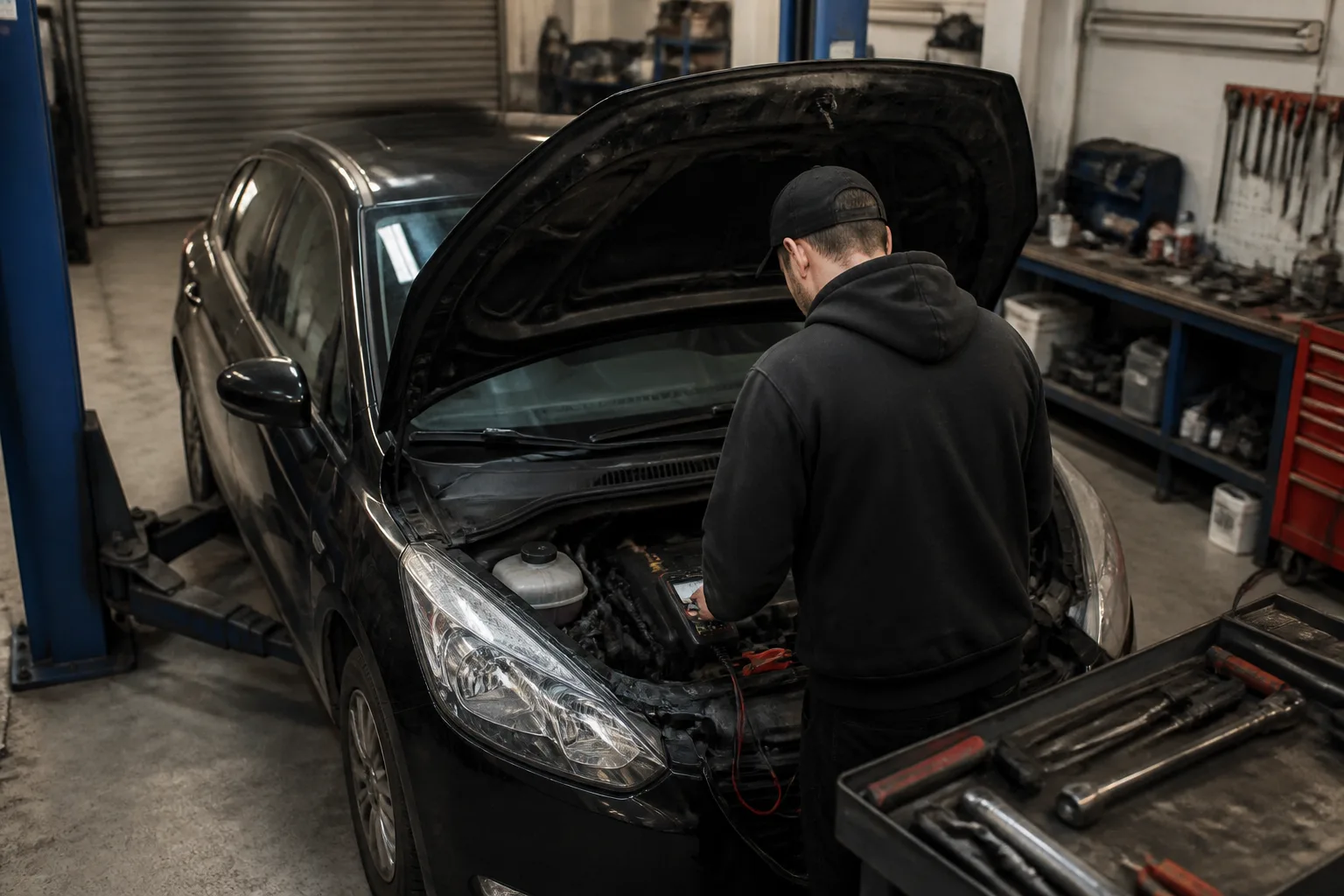
Finding that your car will not start is frustrating, particularly when you are trying to get to work, school or an appointment. The useful first step is not to keep turning the key repeatedly, but to notice exactly what happens when you try.
Does the car remain completely silent? Do you hear a click? Does the engine turn over normally but fail to fire? These symptoms can have different causes. While a few basic checks are reasonable, a starting fault cannot be diagnosed with certainty from symptoms alone. The battery, starter motor, fuel system and engine management system all need to work together.
What happens when you try to start the car?
No lights, sounds or electrical response
If the dashboard stays dark and the car has no obvious electrical response, the battery may be completely discharged. A poor connection at the battery terminals or an issue with the vehicle’s main electrical supply can produce similar symptoms.
Check whether the interior lights, central locking or headlights work. If everything is dead, avoid repeatedly operating electrical equipment, as this may use what little charge remains. A battery can go flat because it is old, because a light or accessory has been left on, or because the charging system has not been replenishing it properly.
A single click or repeated clicking
A click when you turn the key or press the start button may mean that the starter motor is being asked to operate but there is not enough electrical power available. A weak battery or poor battery connection is a common possibility.
Repeated rapid clicking can also be associated with low battery voltage. However, a click does not prove that the battery is the cause. The starter motor, its wiring and the vehicle’s control systems may also need checking.
The engine turns slowly
If the engine turns over much more slowly than usual, the battery may not have enough charge or the battery may be reaching the end of its useful life. Corroded or loose connections can restrict the current needed by the starter motor.
Cold weather can make a marginal battery more noticeable because starting the engine requires more effort. If the car starts after a jump start but then struggles again later, the underlying issue may still be present. It could involve the battery, the alternator, which charges the battery while the engine is running, or an electrical drain while the vehicle is parked.
The engine turns normally but does not start
This is different from a flat battery. If the engine is cranking at a normal speed but does not fire, possible areas include fuel delivery, ignition, engine sensors, the immobiliser system or the engine control system.
Make sure there is fuel in the tank rather than relying only on the fuel gauge, particularly if the gauge has been unreliable. Check whether an immobiliser or security warning is showing on the dashboard and try the spare key if one is available. Do not assume that fitting a new battery will solve a normal cranking but no-start fault.
For more detail on this particular symptom, see our guide to why a car can crank but not start.
Common reasons a car will not start
Flat, weak or failing battery
The battery supplies the high current needed to operate the starter motor and provides power for the vehicle’s electrical systems. A battery may become discharged after the car has been left unused, after an electrical item has been left on, or when a charging fault prevents it from receiving enough charge.
A battery can also deteriorate internally. If your car regularly needs a jump start, that is a reason to investigate rather than simply continue carrying jump leads. Our related guide explains the signs of a failing car battery.
Charging system fault
The alternator normally charges the battery while the engine runs. If the alternator, drive belt, wiring or charging control system develops a fault, the vehicle may eventually lose electrical power even if the battery itself is relatively new.
A battery warning light, dimming lights or repeated starting problems may justify arranging an inspection. If several electrical warning lights appear while driving, or the car begins to lose power, find a safe place to stop and seek professional advice.
Starter motor or starting circuit fault
The starter motor turns the engine so that it can begin running. A worn starter motor, a fault in its solenoid, or a problem with the starter wiring can cause a click, silence or an intermittent starting fault.
Modern vehicles may also prevent the starter from operating if they do not recognise the key, if an automatic transmission is not correctly indicating Park or Neutral, or if a clutch or brake pedal switch is not registering correctly. The exact arrangement varies by vehicle.
Fuel, ignition or sensor problem
When the engine cranks normally but does not start, it needs the correct combination of fuel, air and an ignition signal. A fuel pump or fuel supply problem, an ignition fault, or a failed engine sensor can interrupt that process.
These faults often require proper testing rather than guesswork. Replacing parts at random can be expensive and may not address the cause. Diagnostic equipment can help identify stored fault information, but test results still need to be interpreted alongside the vehicle’s symptoms.
Safe checks you can make
Before arranging help, you can make a few simple observations without dismantling anything:
- Check whether the dashboard, interior lights and central locking work.
- Listen carefully for silence, a single click, repeated clicking or normal cranking.
- Look for warning lights or an immobiliser message on the dashboard.
- Confirm that the vehicle is in Park or Neutral, or that the clutch pedal is fully depressed where appropriate.
- Check the fuel level and whether the key fob battery may be causing a recognition problem.
- Look for obvious loose battery leads or signs of damage, without touching damaged wiring or attempting a repair.
If you use a jump pack or jump leads, follow the vehicle manufacturer’s instructions and use suitable equipment. Do not attempt this if the battery is visibly damaged, leaking, swollen or frozen. If you are unsure, it is safer to ask for assistance.
When should you stop trying to start the car?
Stop and seek professional help if there is a smell of fuel, smoke, melted wiring, sparking, a damaged battery or any other sign of an electrical or mechanical hazard. Do not keep cranking the engine for long periods, as this can place additional strain on the battery and starter motor.
If the vehicle does start but the battery warning light remains on, the engine is overheating, the steering feels abnormal or other serious warning lights appear, avoid continuing to drive unless you have been advised that it is safe. Arrange an inspection or recovery instead.
For a car that repeatedly goes flat, our guide to why a car battery keeps going flat explains why a jump start may only be a temporary answer. You may also find it useful to understand how long a car battery typically lasts, while remembering that actual battery life depends on the vehicle and how it is used.
How a garage can find the cause
A garage can assess the battery’s condition, check the charging system and starter circuit, and carry out appropriate diagnostic tests. If the engine cranks but does not start, further checks may be needed to assess fuel delivery, ignition and relevant sensors.
The aim is to identify the reason for the fault rather than simply replace the most obvious component. If your car will not start or the problem keeps returning, Ashton’s Garage can inspect the starting and electrical system and explain the sensible next step without assuming a diagnosis in advance.
In summary
When asking, “why won’t my car start?”, begin by separating an electrical no-response fault from an engine that cranks but does not fire. A weak battery is common, but it is not the only possibility. Starter, charging, fuel, ignition, immobiliser and sensor faults can all produce similar problems.
Note the symptoms, carry out only safe basic checks and avoid repeated attempts if there is a safety concern. A proper inspection is the most reliable way to find the cause, particularly when the fault is intermittent or returns after a jump start.
Frequently asked questions
Why does my car make a clicking noise but not start?
Clicking can be caused by low battery voltage or a poor battery connection, although the starter motor and its wiring can also be involved. The sound alone cannot confirm the cause.
Can a car fail to start because it has fuel?
Yes. If the engine cranks normally but does not fire, a fault with fuel delivery, ignition, engine sensors or the immobiliser system may be possible. These areas usually need proper testing.
Should I keep trying to start a car that will not start?
Avoid repeated or prolonged attempts. Stop immediately if there is fuel smell, smoke, sparking, damaged wiring, a leaking or swollen battery, or another obvious hazard, and arrange professional assistance.
Why does my car start with a jump but not the next time?
A jump start may provide temporary power without fixing the underlying problem. The battery, alternator, starter circuit or an electrical drain may need checking.
Can cold weather stop a car starting?
Cold conditions can make a weak battery less able to provide the current needed for starting. Other faults may also become noticeable in colder weather, so repeated difficulty should be investigated.
Related advice
What Causes Rough Starting in Cold Weather?
Cold weather can expose a weak battery, worn spark plugs, fuel system fault or sensor problem. Here is what rough starting may mean and when to arrange a garage inspection.
Why Is My Exhaust Smoking More in Cold Weather?
A visible white cloud from your exhaust can be normal on a cold morning, but persistent smoke or a change in colour may point to a fault. Here is how to tell the difference and when to arrange an inspection.
Why Does My Car Smell of Fuel?
A fuel smell should not be ignored. Learn what may cause it, when it could be harmless, and when to stop driving and arrange a professional inspection.