What to Check When Buying a Used Car
A practical UK checklist for inspecting a used car, checking its history and documents, taking a test drive, and deciding when an independent inspection is worthwhile.
Buying a used car can be good value, but it pays to check more than the paintwork and asking price. A car that looks tidy may still have missing history, outstanding faults or details that do not match its official records.
This guide explains what to check when buying a used car in the UK. It covers the vehicle’s history and paperwork, the exterior and interior, the engine bay, the test drive and the situations where an independent inspection is sensible.
Check the car’s details before viewing it
Before travelling to see a car, ask the seller for the registration number, make, model, mileage and vehicle identification number, often called the VIN. The registration number can be used to check information held by the Driver and Vehicle Licensing Agency, or DVLA.
Compare the seller’s description with the official information. Look for differences in the model, fuel type, engine details, recorded mileage and the date of the latest V5C registration certificate. A V5C is the document that records the vehicle’s registered keeper and key vehicle details. It is not proof of ownership, so be cautious if the seller cannot explain why it is unavailable.
You can also check whether the vehicle is taxed or declared off the road, its MOT status and other available details through the official DVLA service. If the seller’s information does not match the records, ask for an explanation before arranging a viewing.
Review the MOT history
The government MOT history service can show previous test results, recorded mileages and defects or advisories. This is useful for identifying patterns rather than simply looking for a recent pass.
- Check that the recorded mileage generally increases over time. A sudden drop needs a clear explanation.
- Read previous advisories, not just the latest result. Repeated notes about tyres, brakes, suspension or corrosion may indicate ongoing maintenance needs.
- Compare the MOT history with the seller’s claims about recent work.
- Check the current MOT status and expiry information before driving the vehicle away.
An MOT is a legal roadworthiness test at the time of inspection. It is not a complete mechanical health check and does not guarantee that a car will remain reliable. A recent pass should therefore be treated as one part of your checks, not as a substitute for inspecting the car.
Check recalls and the vehicle identification number
Ask whether any safety recalls have been completed. A recall is a manufacturer-led action to address a known safety or technical issue on particular vehicles. You can check for outstanding recalls using the relevant official or manufacturer information, then ask the seller for evidence that any work has been carried out.
Locate the VIN on the vehicle and compare it with the VIN shown on the V5C and any available service documents. The exact location varies by vehicle, but it may be visible through the windscreen or in the engine bay or door area. Do not proceed without resolving a mismatch. Differences can be caused by a paperwork error, but they may also indicate a more serious problem with the vehicle’s identity.
Inspect the exterior in good conditions
Try to view the car in daylight, with the bodywork clean enough to inspect. Rain, darkness and heavy dirt can hide scratches, dents and paint differences.
- Walk around the car and look for mismatched paint, uneven panel gaps and overspray around seals or trim. These can suggest previous body repairs, although they do not prove poor-quality work.
- Check the windscreen, lights, mirrors and number plates for damage.
- Look underneath the car for signs of fresh fluid leaks, loose covers or significant corrosion. Do not place yourself under a vehicle that is not safely supported.
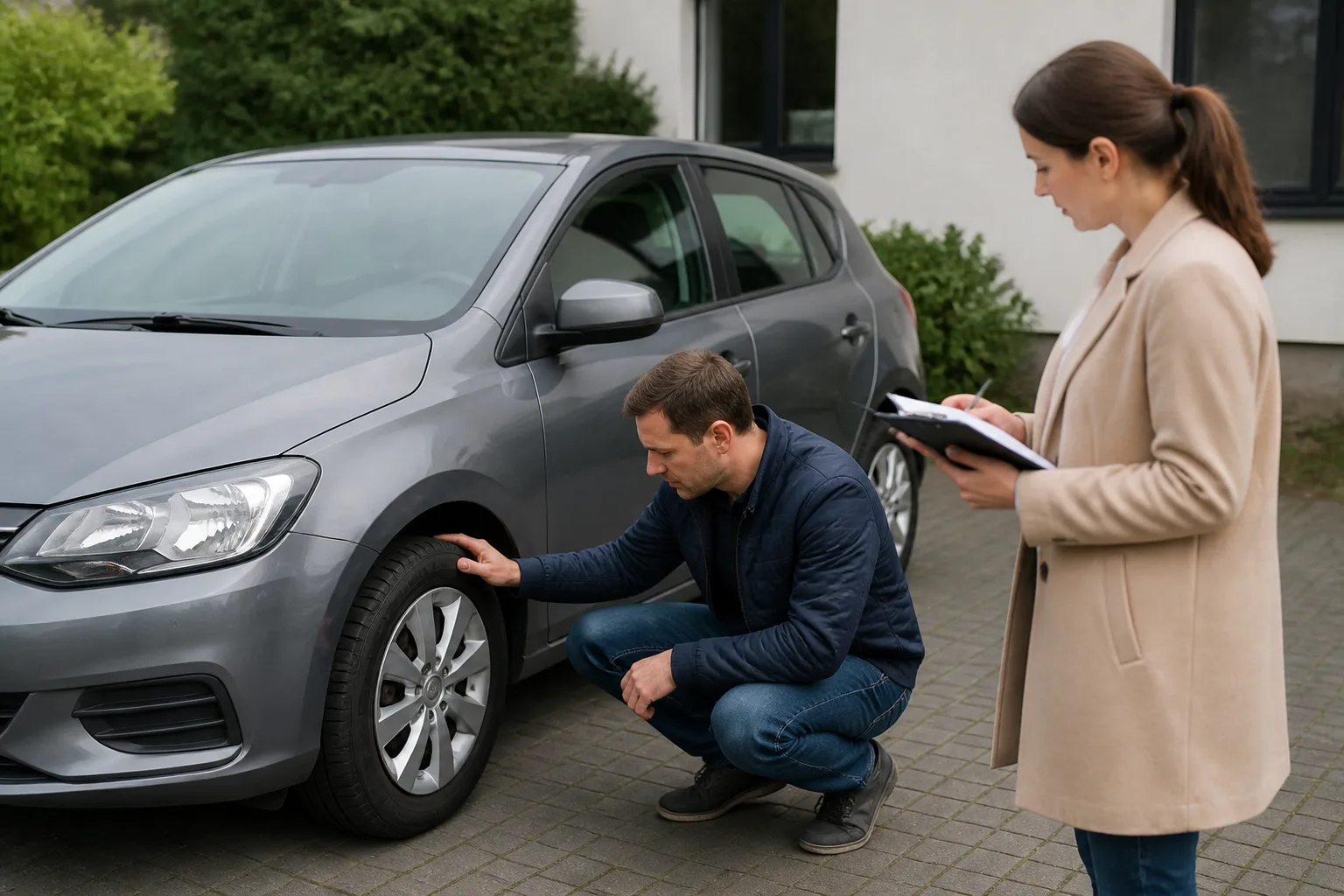
- Inspect each tyre, including the spare if fitted. Look for cuts, bulges, uneven wear and visibly low tread. Uneven wear can have several causes and needs professional assessment if it is pronounced.
- Make sure the tyre sizes and types appear consistent with the vehicle and that warning lights are not showing.
Tyre bulges, serious cuts, exposed cords or other obvious tyre damage are safety concerns. Do not continue driving a car with a dangerous tyre. Ask for the issue to be dealt with before purchase or arrange professional advice.
Look inside the cabin and boot
Check that the seats, carpets and boot condition are consistent with the claimed age and mileage. Heavy wear is not automatically a problem, but unusual wear or damp smells should be investigated.
Switch on the ignition before starting the engine and watch the dashboard. Most warning lights should illuminate briefly as a self-check and then go out after the engine starts. A warning light that stays on, flashes or fails to appear at all needs an explanation. Check the related functions, including the horn, windows, mirrors, central locking, heating, air conditioning, wipers, washers, lights and infotainment system.
Pay particular attention to brake, steering, airbag and engine warning lights. A dashboard light cannot identify the exact fault by itself, so do not assume that it is a minor issue. A fault affecting braking or steering should be professionally inspected before the vehicle is driven further.
For more detail, see our guide to checking dashboard warning lights before buying a used car.
Check the engine bay without taking risks
Look for obvious oil or coolant leaks, damaged wiring, loose components and unusually heavy deposits around fluid caps. Check fluid levels only as the vehicle manufacturer permits and only when it is safe. Do not remove a coolant cap while the engine is hot, as pressurised coolant can cause serious burns.
Ask whether the engine is cold before starting it. A warm engine can sometimes hide starting or running problems, so a seller who has already warmed the car should be able to explain why. From a cold start, listen for unusual knocking, rattling or prolonged cranking. These sounds can have different causes and cannot be diagnosed reliably from a brief viewing.
Blue, white or unusually heavy exhaust smoke is another reason to pause and seek professional advice. It may be harmless in limited circumstances, but it can also indicate a fault. Do not buy on the assumption that a concerning symptom will be inexpensive to fix.
Take a proper test drive
Make sure you are insured and legally allowed to drive the car, and follow the seller’s arrangements. Test the vehicle on roads that allow you to assess low-speed manoeuvring, normal acceleration and braking. Keep the radio off so you can hear the car.
- Check that the engine starts promptly and settles into a reasonably consistent idle.
- Try the clutch and gears gently. Juddering, slipping, difficulty selecting gears or unusual noises should be investigated.
- Check that the car tracks normally and that the steering does not feel excessively loose, heavy or uneven.
- Brake progressively in a safe, suitable place. Pulling, vibration, grinding or a soft pedal should not be ignored.
- Listen for knocks or humming from the suspension and wheels, particularly over controlled changes in road surface.
- Confirm that the temperature gauge behaves normally and that no overheating warning appears.
If the brakes, steering or temperature system show a serious warning sign, stop the test drive safely and do not continue driving until the car has been inspected. A test drive is not a substitute for a mechanical inspection.
Ask for service and ownership records
Look for invoices, service stamps, repair records and information about parts replaced. Check that the dates and mileages make sense alongside the MOT history. A service book is helpful, but it may not contain every repair, particularly if work was carried out by an independent garage.
Ask specifically when routine items were last replaced or checked, such as tyres, brakes, the battery and timing belt where the vehicle has one. The correct maintenance interval depends on the manufacturer, engine and usage, so check the handbook or manufacturer guidance rather than relying on a general rule.
Our related guide explains what service history a used car should have, while this article covers what a vehicle service book means and what it does not prove.
Arrange an independent inspection if you are unsure
An independent inspection can be worthwhile before you commit to a purchase, particularly for an expensive car, an older vehicle, a private sale or a car with limited history. A garage can assess areas that are difficult to judge on a short viewing, although no inspection can predict every future repair.
Ask the garage what the inspection includes and whether it will be carried out on a ramp. If the seller refuses a reasonable inspection or will not allow enough time for basic checks, treat that as a reason to pause rather than pressure yourself into a decision. If you would like advice about arranging a check, you can contact Ashton's Garage about vehicle servicing and inspection options.
Use a simple decision checklist
Before agreeing to buy, make sure you can answer these questions:
- Do the seller, vehicle, VIN and documents match?
- Does the MOT history support the mileage and maintenance claims?
- Are there any unresolved recalls, warning lights or safety concerns?
- Have you inspected the tyres, bodywork, fluids, interior and boot?
- Did the car behave acceptably during a proper test drive?
- Have you allowed for servicing or repairs identified during your checks?
If the answers are unclear, take more time or seek an independent opinion. Walking away from one car is usually better than buying a vehicle whose history or condition you cannot understand.
Frequently asked questions
Should I buy a used car without a V5C?
You should be cautious. The V5C records important vehicle details, but it is not proof of ownership. Ask the seller why it is unavailable and compare the vehicle identification number and other details with official records before making a decision.
Does a recent MOT mean a used car is reliable?
No. An MOT checks specific roadworthiness items at the time of the test and is not a full mechanical inspection. Review the MOT history, service records and current condition as well.
What warning lights should stop me buying a used car?
Brake, steering, airbag, engine and overheating warnings should all be investigated. The light alone does not identify the fault, so arrange a professional inspection and do not continue driving if the vehicle may be unsafe.
Is it worth having a used car inspected before buying?
An independent inspection can be worthwhile, especially for an older car, a private sale, a vehicle with limited history or a purchase that would be difficult to replace financially. It can identify current concerns that are easy to miss during a short viewing.